The road was dark and quiet when a county sheriff’s deputy noticed a woman walking near the edge of the street.
She had apparently just left a nearby 7-Eleven and was making her way through a residential area on foot.
According to the narration accompanying the uploaded video, the woman was walking against the legally required direction for that particular stretch of road—or otherwise moving in a way the deputy believed violated pedestrian rules and created a safety concern.
The issue appeared minor.
Nobody had reported a violent crime.
The deputy was not responding to a robbery, assault or armed suspect.
He wanted to stop the woman, explain the problem and identify her before deciding whether to issue a warning or citation.
It should have taken less than a minute.
Instead, the encounter became a prolonged roadside struggle involving accusations, physical resistance, arriving backup officers and several confused bystanders.
The Deputy Attempts to Speak From His Vehicle
The deputy initially tried to address the situation without immediately jumping from his patrol vehicle.
He drove near the woman and apparently attempted to speak with her through the open window.
From the woman’s perspective, she had simply left the convenience store and begun walking home. She did not understand—or did not accept—why a deputy had suddenly decided to question her.
She continued moving.
The deputy tried again to get her attention.
The video’s captions describe the stop as an attempt to address a pedestrian walking against the flow of traffic. Whether the woman agreed with that interpretation did not change the deputy’s decision to conduct the stop.
He exited the patrol vehicle.
That was the moment a potentially simple interaction began changing.
“All I Did Was Leave a 7-Eleven”
The woman immediately argued that she had done nothing wrong.
She repeatedly referenced the convenience store and insisted that she had merely walked away from it. To her, the deputy’s attention appeared unnecessary and possibly suspicious.
But the deputy was not accusing her of committing a crime inside the store.
The concern was how she had been walking along the road afterward.
Rather than remain still and listen to the explanation, the woman continued questioning the deputy’s authority.
She wanted to know why she had been stopped.
When he attempted to explain, she spoke over him.
When he requested information, she refused to provide it.
The disagreement became less about the original pedestrian issue and more about whether she would cooperate long enough for the deputy to complete the stop.
The Accusations Begin
The woman’s frustration quickly became personal.
She accused the deputy of being dishonest and called him a “dirty cop.”
She demanded that he contact a supervisor, repeatedly referring to the person she wanted as his “boss man.”
Requesting a supervisor was not necessarily a problem. People involved in police encounters can ask whether a higher-ranking officer is available.
But demanding a supervisor does not automatically suspend the instructions already being given by the officer at the scene.
The woman appeared to believe that once she requested the deputy’s superior, she no longer had to cooperate with him.
The deputy disagreed.
He continued trying to obtain her identity and keep her from walking away.
Refusing to Be Identified
The woman would not calmly provide her name.
Without identifying information, the deputy could not determine who she was, whether the information she gave was accurate or how to document the original pedestrian violation.
The longer she refused, the less likely it became that the encounter would end with only a quick conversation.
The deputy moved closer and informed her that she was being detained.
She pulled away.
The situation had now crossed an important line.
The deputy was no longer simply asking her to remain.
He was physically attempting to prevent her from leaving before the stop was complete.
The woman responded by resisting his grip.
The Patrol Vehicle Becomes the Center of the Struggle
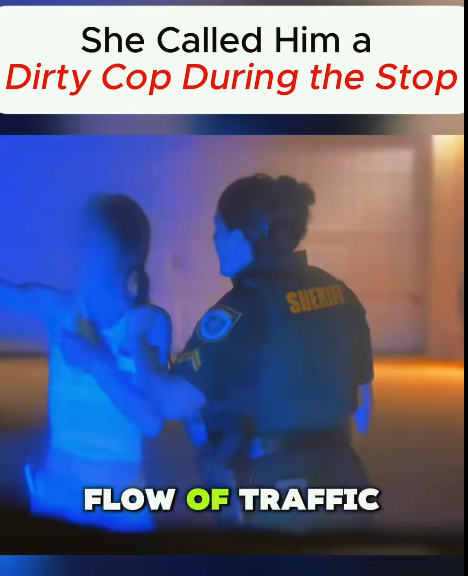
The body-camera footage shows the confrontation moving beside the sheriff’s vehicle.
Emergency lights flash across the woman’s white top and the surrounding houses. The road and nearby lawns alternate between darkness and intense blue, red and green reflections.
The deputy attempts to control one of her arms.
She twists her shoulders away.
He tries to position her against the vehicle so she cannot continue walking or strike him accidentally during the struggle.
She resists.
The woman argues that the officer is escalating the situation. The deputy responds that her refusal to cooperate is creating the physical confrontation.
Both continue speaking at the same time.
She demands that he stop touching her.
He orders her to remain still and place her hands where he can control them.
The disagreement has now become exactly what the deputy appeared to be trying to avoid: a physical encounter over an extremely minor original violation.
Backup Arrives
Another deputy reaches the scene.
The arriving officer sees the woman struggling beside the patrol vehicle and moves in to assist. The two deputies attempt to control her arms without allowing the confrontation to move into the road.
The woman becomes louder.
She continues accusing the first deputy of wrongdoing and insists that she is being targeted without justification.
She repeatedly requests a supervisor.
The deputies continue ordering her to stop resisting.
The body-camera view becomes unstable as the officers reposition themselves. At times, the woman appears pressed against the hood or side of the patrol vehicle while they attempt to bring her hands behind her.
The struggle is sustained rather than instantaneous.
Every time the officers appear close to gaining control, she shifts her body again.
“Someone Call 911!”
People nearby begin watching.
The flashing patrol lights and raised voices draw attention from the surrounding area. The woman appears aware of the audience and calls out for help.
She demands that someone contact 911.
The request creates a strange moment.
The emergency number she wants someone to call would connect the bystander to the same law-enforcement system already represented by the deputies beside her.
An officer at the scene points out that they are law enforcement.
But the woman apparently does not view the deputies restraining her as people who are there to help. She sees them as the source of the emergency.
Her calls to the bystanders intensify the spectacle.
People watch from the sidewalk while she continues struggling against the officers.
Why the Officers Did Not Immediately Take Her to Jail
By this stage, the deputies could have interpreted several parts of the woman’s behavior as grounds for additional allegations.
She had refused to stop.
She had resisted their attempts to detain her.
She had turned a pedestrian citation into a physical confrontation requiring backup.
Yet the narration says the officers were still attempting to avoid a custodial arrest.
Their immediate goal was to gain control, determine her identity and end the danger without transforming the incident into a trip to jail.
That restraint did not mean they allowed her to walk away.
It meant that even after the confrontation became physical, they continued looking for a resolution short of arrest.
Eventually, the woman’s resistance decreased enough for the deputies to complete the identification process.
She Is Finally Identified
Once the officers confirmed who she was, the original purpose of the stop could finally be completed.
The narration states that she was issued a pedestrian violation.
The footage does not clearly show the exact statutory wording printed on the citation, and it does not provide enough information to determine whether she later challenged it in court.
What it does show is that the deputies did not place her into the back of the patrol vehicle for transportation to jail.
She remained at the roadside.
Despite the accusations, the struggling and the arrival of backup, she was going to be released.
The resolution was far less severe than the confrontation might have suggested.
The Argument Continues After the Decision
Being released did not end the woman’s criticism.
She continued talking about the deputy’s conduct while another officer completed the paperwork.
At one point, she appeared to warn that the incident would be posted online. She suggested that once the public saw the video, people would recognize what kind of officer had stopped her.
The deputy remained beside her while the citation was prepared.
She continued insisting that the encounter revealed corruption or misconduct.
From her perspective, the fact that she had been physically restrained over a pedestrian issue proved that the stop had been abusive.
From the deputy’s perspective, the physical restraint became necessary only after she refused to remain, identify herself or allow the stop to be completed.
The footage would later allow viewers to form their own opinions.
The Woman Receives the Citation and Walks Away
The encounter ultimately ends without an arrest.
The woman is given the pedestrian citation and released.
No ambulance transports her from the scene.
No patrol vehicle takes her to jail.
No serious injury is visible in the uploaded clip.
The officers remain behind as she prepares to leave the roadside.
The original violation was still documented, but the additional confrontation did not produce the most severe possible consequence.
The narration presents that outcome as evidence of de-escalation.
The deputies had gained physical control when necessary, but once the woman was identified and the citation was issued, they allowed the interaction to end.
A Stop Transformed by Distrust
The most revealing part of the footage is not the original pedestrian violation.
It is the complete absence of trust between the woman and the deputy.
The moment he approached her, she appeared to assume that his intentions were dishonest.
She did not believe his explanation.
She did not believe she needed to provide information.
She interpreted his attempt to detain her as proof that he was corrupt.
The deputy, meanwhile, interpreted her refusal to stop as a deliberate decision to prevent him from performing his duty.
Each person viewed the other’s next action through that distrust.
When he stepped closer, she believed he was escalating.
When she pulled away, he believed greater control was necessary.
When he attempted to restrain her, she fought harder.
The cycle continued until several officers were struggling beside a patrol vehicle over a violation that should have required only a conversation.
Asking for a Supervisor Did Not Pause the Stop
The woman repeatedly demanded the deputy’s supervisor.
That request became central to her argument.
She appeared convinced that the first deputy should stop all enforcement activity until a higher-ranking officer arrived.
But the deputy continued the detention.
A person may request another officer, but the request itself does not necessarily prevent the officer already present from completing an active stop.
The safer option would have been to remain still, provide the requested information and continue asking for a supervisor without physically resisting.
Instead, the woman attempted to force the issue by refusing cooperation.
That decision made the arrival of additional officers more likely—but not in the way she had hoped.
They arrived as backup during a struggle.
Resisting Did Not Make the Original Question Disappear
The woman seemed to believe that if she argued forcefully enough, the deputy would have to abandon the stop.
The opposite happened.
The more she refused, the longer the encounter lasted.
The more she pulled away, the more physical control the officers used.
The more she demanded that bystanders intervene, the larger the audience became.
Yet after all of it, the officers still obtained her identity and issued the citation.
Nothing she did made the original issue disappear.
Her resistance only added fear, public humiliation and the possibility of more serious consequences.
The Officer’s Final Choice
The video’s most important moment may be the one that appears least dramatic.
After the struggle ended, the deputy did not insist that the woman be booked into jail simply because she had insulted him or accused him of corruption.
He did not appear to add punishment because she threatened to post the incident online.
The deputies completed the original enforcement action and released her.
That choice does not automatically prove every tactic used during the struggle was perfect. Viewers may still disagree about when physical contact became necessary or whether the deputy could have explained the stop differently.
But the ending demonstrates that the officers were willing to let the confrontation end once their immediate objectives were complete.
Thirty Seconds Became Several Chaotic Minutes
The woman left the 7-Eleven expecting to walk home.
The deputy saw what he believed was a pedestrian violation.
One brief explanation could have resolved the matter.
Instead, the encounter became a public argument under flashing emergency lights.
She called the deputy corrupt.
She demanded his supervisor.
She resisted his attempts to detain her.
She called for bystanders to summon the police while police were already standing beside her.
And after a sustained struggle, she received the same pedestrian citation that might have been issued minutes earlier without any physical confrontation.
The woman was ultimately released without arrest.
That outcome prevented the incident from becoming even more serious.
But it also left behind a body-camera recording showing how distrust and refusal can turn one of the smallest police encounters into one of the loudest moments on an otherwise quiet street.