The night appeared quiet before the police lights arrived.
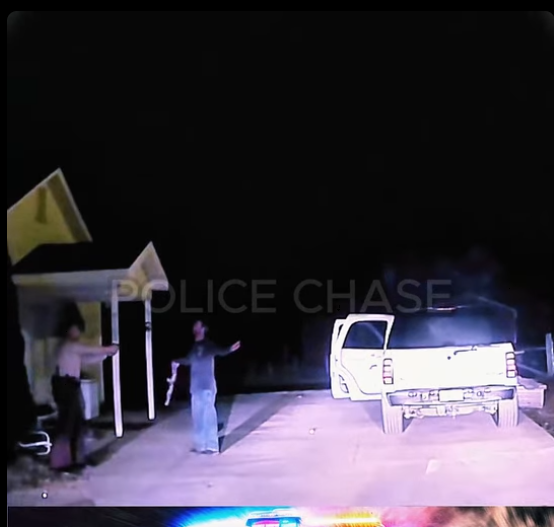
A small house stood beside a dark driveway. Near the porch was a white pickup truck with its driver’s door open, as though someone had climbed out only moments earlier.
In front of the truck stood an adult man wearing a dark long-sleeved shirt, blue jeans and work boots.
Several officers were nearby.
The video does not show why they had come to the property. There is no visible collision, injured person, weapon or damaged home. The edited clip also provides no dependable introduction explaining whether officers were responding to a complaint, conducting an investigation or attempting to make an arrest.
What it does show is a confrontation already under pressure.
The Video Opens With the Takedown
Instead of beginning with the conversation, the edit immediately reveals its most dramatic moment.
An officer moves quickly toward the man.
The two collide beside the rear of the pickup and fall heavily onto the driveway.
The man turns and struggles as the officer attempts to control him. Another officer runs into view, followed by at least one more person joining the effort.
Within seconds, several bodies are crowded together on the ground.
Then the video abruptly changes.
The same man is standing again.
The takedown has not been reversed in real life. The editor has returned to an earlier point in the encounter so viewers can watch the tension build toward the moment they have already seen.
The Man Stands Beside the Open Truck
In the longer sequence, the man remains near the white pickup while an officer faces him from several yards away.
The patrol vehicle’s bright lights wash out much of the scene. Shadows stretch across the driveway, and the house behind them is barely visible beyond the porch.
The man gestures repeatedly.
At times, he raises one or both hands. His posture appears animated rather than relaxed, suggesting an intense argument or disagreement.
The officer maintains his position.
The exact conversation cannot be verified. The audio is heavily compressed and covered by the social-media edit, making individual statements unreliable.
That uncertainty matters.
A viewer cannot safely determine whether the officer was ordering the man to remain still, surrender an object, step away from the truck or submit to arrest.
It is equally impossible to confirm what the man was saying in response.
The footage provides body language—but not the complete context behind it.
Someone Watches From the Porch
Another person can be seen near the house during portions of the confrontation.
That individual remains close to the porch and does not appear to enter the eventual struggle.
Their presence suggests the officers may have been speaking with more than one person at the property, but the clip gives no explanation of their role.
They could have been a resident, witness, relative or someone connected to the original call.
Without the unedited footage, any more specific claim would be speculation.
The focus remains on the man near the truck.
The Distance Begins to Disappear
For several seconds, the man and the officer continue facing one another.
The man lifts his hands and gestures again.
Then he begins moving.
Whether he intended to approach the officer, return to the pickup or simply reposition himself cannot be determined from the camera angle alone.
What is visible is that the space between them becomes smaller.
The officer also moves forward.
Their verbal confrontation is about to become physical.
There is no lengthy warning visible in the final seconds of the edit. No dramatic pause separates the argument from the takedown.
One moment, both men are standing.
The next, the officer reaches the man and attempts to control him.
The Sudden Collision
The officer grabs hold of the man as they move beside the pickup.
Their momentum carries both of them toward the pavement.
The man does not immediately remain still. His body continues twisting as the officer tries to secure his arms and prevent him from getting back onto his feet.
A second officer runs toward the struggle.
Then another arrives.
The scene becomes difficult to follow because the people on the ground overlap one another and the bright patrol lights obscure smaller movements.
The officers appear to divide the task.
One focuses on controlling the man’s upper body.
Another moves near his legs.
A third stands or kneels nearby, ready to assist as the group shifts across the driveway.
The man remains physically active beneath them.
Why Multiple Officers Joined
The clip does not provide enough information to determine whether the man attempted to strike anyone before the takedown.
It also does not clearly show whether he reached toward a pocket, the truck or police equipment.
What the footage does show is that one officer did not immediately gain complete control after taking him to the ground.
That is when the others joined.
A ground struggle can become unpredictable rapidly. Arms disappear beneath bodies, equipment becomes exposed, and an attempt to stand can move everyone toward a vehicle or roadway.
The arriving officers appeared focused on immobilizing the man and bringing his hands under control.
No firearm discharge is shown.
No Taser deployment is clearly visible.
No obvious serious injury appears in the uploaded segment.
The Truck Door Remains Open
Throughout the encounter, the pickup’s open driver’s door remains an important part of the scene.
It indicates that the man or someone else may have recently exited the vehicle. It may also explain why officers appeared concerned about controlling his movement near the truck.
But the video never shows officers searching the cab, recovering an object or explaining why the door was open.
The truck becomes the visual center of the confrontation without providing the answers viewers need.
Was the man its driver?
Had police followed him to the property?
Had he been ordered to move away from it?
The edit leaves every question unresolved.
The Struggle Continues
As the final seconds pass, additional officers surround the man.
One person appears to direct or signal while others remain on the ground. The man’s movements become more limited as the officers control different parts of his body.
The video ends during the restraint process.
It does not clearly show him being placed into a patrol vehicle.
It does not display a booking photograph, charging list or court result.
There is no official statement explaining whether he was arrested, cited, medically evaluated or released.
The dramatic takedown is shown twice.
Its legal aftermath is not shown at all.
What the Viral Edit Encourages Viewers to Assume
Short police clips are often structured around one explosive moment.
The confrontation is shown first.
The context is provided later—or not provided at all.
That editing style creates immediate emotion. Viewers see the man hit the ground before they know what officers had said, why they were present or whether the person had already been told he was under arrest.
Some will automatically assume the officers used unnecessary force.
Others will assume the man must have threatened them.
Neither conclusion can be proven from this excerpt alone.
The camera captures a real physical confrontation, but the edit removes the information required to judge everything that led to it.
What Can Be Said With Confidence
Several details are visually clear.
The encounter occurred at night beside a residence.
A white pickup was parked with its driver’s door open.
The man and an officer engaged in a prolonged, tense exchange.
The man repeatedly gestured and later moved closer to the officer.
Physical contact followed.
The officer brought him to the ground, and several others joined the effort to restrain him.
Beyond those observations, caution is necessary.
The reason for the police response is not identified.
The exact commands cannot be reliably heard.
No alleged offense is stated.
No final outcome is provided.
A Confrontation Without Its Beginning or Ending
The footage is compelling precisely because it feels incomplete.
It shows the instant calm disappears—but not what created the tension.
It shows several officers restraining one man—but not what happened after they gained control.
It shows an open vehicle, a nearby home and at least one witness—but gives none of them context.
The encounter may have begun long before the social-media clip starts.
There may be another body camera, a dispatch recording or a police report that explains every decision.
None of those materials appears in the uploaded video.
For now, the most accurate description is also the simplest:
A tense nighttime argument beside a pickup suddenly became a ground struggle. Multiple officers rushed in, and the man was restrained.
The dramatic images are clear.
The full story behind them remains hidden outside the frame.