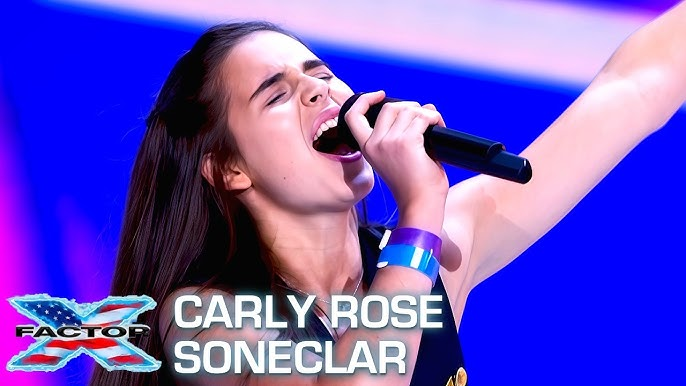
Carly Rose Sonenclar walked onto The X Factor USA stage in 2012 with the kind of shy smile that makes you immediately want to protect someone — not because she seemed fragile, but because she seemed so genuinely unassuming. At just 13, she introduced herself with a quiet confidence, talking about her love for music and the dream that had brought her to that enormous arena. In the world of reality television, where stagecraft and backstory often arrive packaged and polished, Carly’s plainspoken presence felt refreshingly real. The judges listened politely, perhaps a little curious, wondering how this small, soft-spoken girl would hold up under the pressure of one of the most scrutinized audition stages in the country.
That curiosity turned to stunned silence the instant she opened her mouth. Choosing Nina Simone’s “Feeling Good” was a bold move for any singer, let alone a teenager, because the song asks for both emotional maturity and vocal command. Carly didn’t treat it like a cover; she inhabited it. From the first low, smoky lines she delivered, it became clear this was not a typical adolescent performance. Her tone carried a depth — a bluesy richness — that seemed to come from somewhere older and wiser than her years. There was a natural phrasing to the way she navigated the melody, an understanding of where to linger on a word and where to push for impact.
Small details added to the power of the moment. She didn’t contort her face for dramatic effect or flail for attention; instead, she used subtle facial expressions and precise breath control to shape each phrase. When she reached the song’s more expansive sections, her voice didn’t strain — it blossomed. The high notes were not just hit; they were placed with confidence and artistic taste. You could see people in the audience exchanging looks: disbelief, then excitement, then an almost reverent appreciation. By the time Carly hit the climactic moments, there was a ripple that spread through the crowd until the entire auditorium was on its feet, giving her a standing ovation that felt as much like recognition as it did reward.
The judges’ reactions were immediate and visceral. L.A. Reid and Simon Cowell, both seasoned veterans of the music industry, looked genuinely stunned, their usual composures briefly undone by the sheer magnitude of what they had just heard. Simon’s disbelief was almost audible when he commented on the maturity of her voice — a comment that underlined the impossibility of reconciling the 13-year-old onstage with the soulful, world-weary sound that had just filled the arena. Britney Spears and Demi Lovato, each with their own experiences of stardom beginning in youth, were visibly moved, their expressions reflecting a mixture of admiration and protective awe. The judges didn’t just praise her technique; they recognized an artist who could connect — someone who’d managed to make a classic feel urgent and new.
Beyond the immediate thrill of that audition, there were clues to Carly’s preparedness that explained why the performance landed so profoundly. She had a control and a respect for the material that suggested deep listening and disciplined practice. Her choice to sing something rooted in jazz and soul instead of a current pop hit showed artistic courage: she trusted her instincts and the strengths of her voice rather than relying on a safe, crowd-pleasing selection. That decision, and the way she executed it, marked her as someone thinking like a musician rather than a contestant.
The four enthusiastic “Yes” votes she received were almost ceremonial after such a decisive audition, yet they mattered. They validated the sense that this was the beginning of something larger. Carly went on to become one of the season’s most talked-about contestants, eventually finishing as the runner-up — a testament to the promise that moment revealed. But the audition itself remains memorable not only for the technical perfection of her singing, but for the emotional truth at its core: a young artist laying claim to a sound that felt timeless.
It’s worth noting the broader significance of a performance like Carly’s on a platform such as The X Factor. Reality TV often trades in manufactured drama and momentary sensations, but every so often a performance arrives that resists commodification because it is, in essence, honest. Carly’s rendition of “Feeling Good” did just that — it transcended the audition format and became a pure musical moment. Viewers at home didn’t just watch a clip; they felt it. The audition circulated widely, not because of flashy staging or a tearful backstory, but because audiences recognized raw artistic authenticity.
Looking back, the picture that lingers is of a young girl who stood small on a monumental stage and, through sheer talent and musical sensitivity, made it her own. Her voice that night did more than impress judges or win votes; it announced the arrival of a rare performer capable of bridging generations of music. For many, that audition remains a benchmark — a reminder that sometimes the quietest people hold the loudest talents, and that age is often a poor guide to the depth of a musician’s soul.