Marcos Almeida didn’t remember the exact moment his world split in two. He remembered the rain pounding against the windows. He remembered the phone vibrating on the kitchen table. He remembered an unfamiliar voice saying “Rodovia dos Imigrantes.”
Ana Clara, his wife, had gone out that afternoon to take care of some family matters and buy a few small things for Miguel. She was two months away from giving birth. At home, a crib still sat unassembled against the wall.
Miguel’s room smelled of new wood, baby soap, and dried paint. Ana Clara had folded the first set of linens with a patience that moved Marcos. Each sock seemed like a small, ridiculous promise.
When they told him the car had lost control on the wet track, Marcos felt the voice on the phone drift away. They spoke of impact, of a barrier, of immediate death. Technical terms. Clean words.
Nothing clean happens when someone tells you that your pregnant wife won’t be coming home.
Ana Clara and Marcos had met eight years earlier in a bank line in São Paulo. She laughed easily, but not with just anyone. He said he fell in love when he saw her defend an elderly woman who had lost her place.
They married without a big party, with a simple meal and a table full of relatives who offered too many opinions. Ana Clara was the kind of woman who kept receipts, ultrasounds, medical notes, and greeting cards as if each piece of paper could save a memory from oblivion.
That’s why the blue folder existed. Inside were Miguel’s ultrasound scans, the results of his last obstetric appointment, the name of the Hospital das Clínicas written on a sheet of paper, and a list of things that still needed to be bought before the birth.
Gustavo, Ana Clara’s brother, had been a part of their lives for years. He ate at their house, took out small loans, and said that the family should help each other. Marcos never liked him very much, but Ana Clara trusted him.
That was the first mistake that would later hurt differently.
Trust isn’t always broken with a shout. Sometimes it’s broken with a borrowed key, a repeated private conversation, and a debt no one acknowledges until there’s blood on the asphalt.
On the night of the accident, Gustavo called Marcos twice before the police did. In the first call, he only asked if Ana Clara had arrived yet. In the second, he sounded agitated, but not surprised.
Marcos didn’t think about that then. Grief reduces the world to a single phrase: she’s gone. Everything else is left out, waiting its turn.
Ana Clara’s body was handled according to standard procedures. There were documents, signatures, a cremation authorization, and a scheduled time for the following day. Every step seemed designed to move forward even though her husband couldn’t breathe.
At the Vila Alpina Crematorium, in the eastern part of São Paulo, the air had an eerie weight. The flowers smelled overly sweet. The white lights made everything seem official, as if the tragedy required administrative illumination.
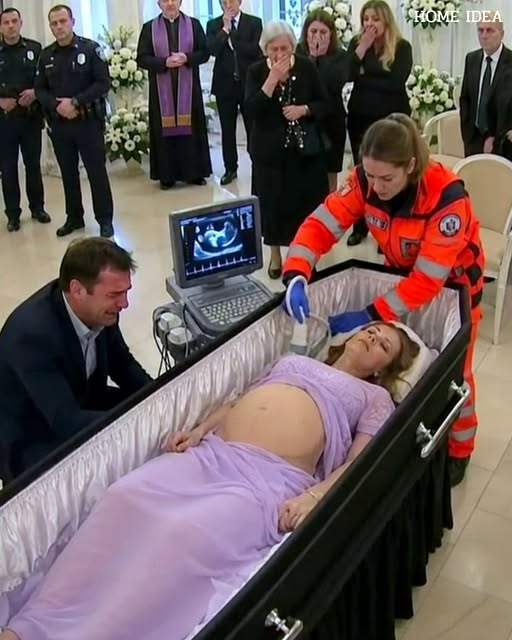
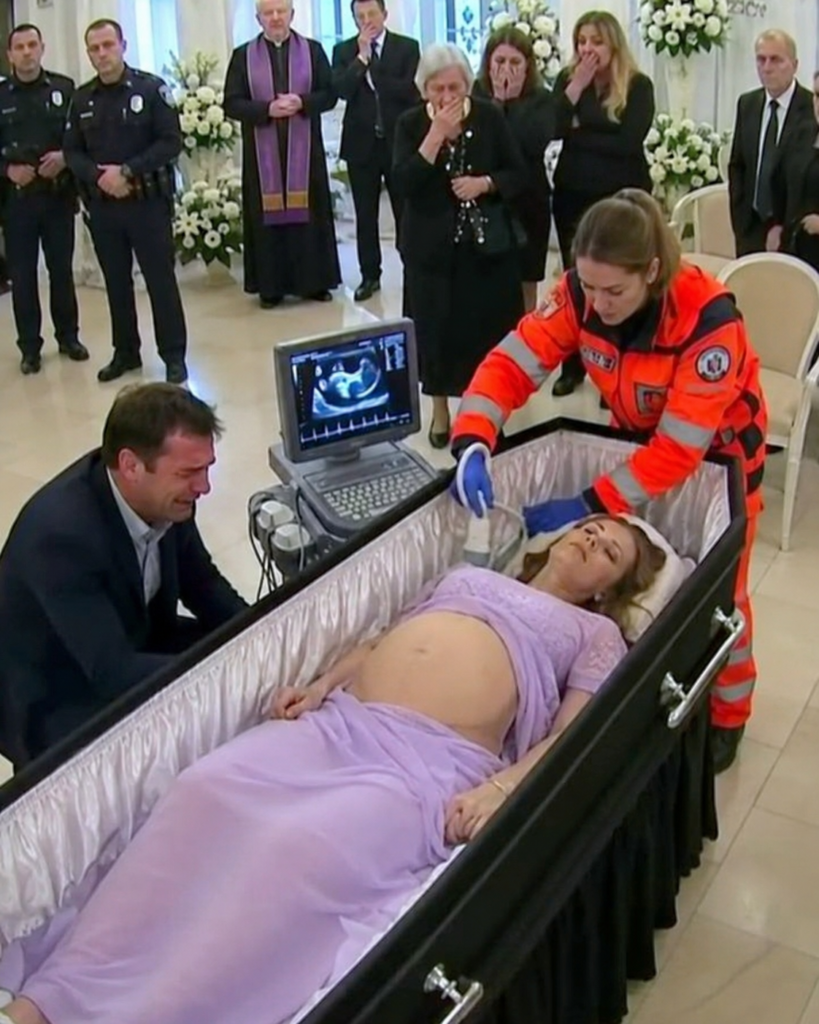
Marcos stood beside the coffin, his hands digging into the dark wood. Ana Clara lay inside, pale and motionless, prepared by hands that had never loved her. Her seven-month pregnant belly still rose beneath the cloth.
Ana Clara’s mother wept, clutching a rosary in her fingers. Gustavo stood against the wall, arms crossed, eyes red. He looked like a sad man, as long as no one stared at him for too long.
An employee approached with the authorization folder. The time was written in the upper corner. Marcos saw the pen, saw the line where they awaited his confirmation, and felt an animalistic resistance in his chest.
“I need to see her one more time,” he said.
The employee hesitated. He explained the procedure with a gentleness that was perhaps meant to be human. Marcos didn’t hear the end. He repeated the same phrase. One last time. Please.
When they opened the lid, the entire crematorium seemed to freeze. Ana Clara’s mother stopped praying. An aunt held a glass halfway to her mouth. An employee looked down at his shoes.
Nobody moved.
Marcos leaned over Ana Clara. He was going to apologize, though he didn’t know why. He was sorry for not being in the car. He was sorry for not arguing harder to stop her from going out in the rain.
Then he saw the belly move.
It was minimal. A tremor that anyone with less love would have dismissed. Marcos blinked, swallowed, and waited. Silence filled his ears until it happened again.
A small movement. Weak. Alive.
“Stop!” he shouted. “Stop everything now!”
The employees tried to explain the possibilities to him. Muscle reaction. Gases. Post-death phenomena. Marcos heard words that sounded memorized and felt something inside him turn cold.
He leaned toward Ana Clara and called her name. There was no response. She didn’t open her eyes. She didn’t breathe. But inside her body was a child still fighting against everything the adults had decided for him.
“Call the ambulance!” Marcos shouted. “My son is alive!”
Chaos erupted immediately. Someone rushed toward the administration office. Another employee called emergency services. Ana Clara’s mother stood up crying, and Gustavo took a step forward before stopping with a rigidity that Marcos would never forget.
In pain, there are details that are recorded as evidence.
Gustavo didn’t look at the belly. He looked at the door. Then he looked at the blue folder. Then he looked at Marcos like someone trying to gauge how much another person knows.
The sirens arrived a few minutes later. The sound came through the glass doors and cut through the room. The paramedics from SAMU came down with bags, gloves, and a haste that turned the funeral into a medical scene.
One of them asked for space. He placed a sensor on Ana Clara’s belly. For a few seconds there was nothing. Only interference, held breaths, and the buzzing of lights.
Then the heartbeat appeared.
It was weak. Fast. Almost impossible. But it was a heart.
“The baby is alive,” said the paramedic.
Marcos clutched his head and slumped against the edge of the coffin. Ana Clara’s mother let out a cry that sounded not like mourning, but like terror mixed with hope. Gustavo stepped back.
The Civil Police were called because the body could no longer be taken to the crematorium. Not with a live baby inside. Not with a signed authorization lying on a table. Not with so many questions arising all at once.
An officer reviewed the basic documents, without yet touching anything related to the expert report. In the blue folder were ultrasound scans, a copy of the preliminary accident report, and a medical note that Marcos didn’t understand.
The time didn’t match.
It wasn’t conclusive proof. It wasn’t an indictment. But it was a crack. And sometimes an investigation begins exactly like that, with a small number that refuses to fit.
Ana Clara was rushed to Hospital das Clínicas. Marcos got into the ambulance without asking permission. No one dared to make him get out. During the journey, he held his wife’s cold hand and spoke with Miguel.
“Hang on, son,” he whispered. “Your dad is here.”
The sound of the machinery mingled with the siren. Every curve seemed like a threat. Every traffic light added another second between Ana Clara’s death and the possibility of saving her son.
At the hospital, the team was already waiting. Doctors, nurses, and obstetricians whisked Ana Clara down the corridor at a speed that left no room for questions. Marcos tried to follow, but they stopped him at the door of the surgical center.
—Sir, you must wait here.
“I can’t lose them both,” he said, almost voiceless. “I’ve already lost her. I can’t lose him too.”
A nurse held his arm. She didn’t promise miracles. She just told him they would do everything they could. For Marcos, that was the cruellest and most necessary phrase of the night.
The door closed.
The hallway smelled of disinfectant, stale coffee, and damp fabric. Marcos was still wearing his crematorium suit, wrinkled and stained by the incense. He sat down, stood up, walked around, and sat down again.
At 6:32 p.m., according to the admissions clock, a doctor left to request urgent authorization. At 6:41 p.m., a nurse walked in with blood on her gloves. At 6:49 p.m., no one was saying anything.
Then a cry was heard.
It wasn’t strong at first. It was sharp, broken, too small. But it pierced the corridor like a light breaking through a closed space.
Miguel was alive.
A nurse appeared with the baby wrapped in white cloth. It was tiny. Red. Furious. It struggled to breathe with a force that seemed too strong for such a small body. Marcos fell to his knees.
They let him see her for just a few seconds before taking her to neonatal intensive care. Marcos didn’t mind. Those few seconds were enough for him to know that something of Ana Clara was still fighting in the world.
But the miracle didn’t end the story. It opened it.
During surgery, doctors found a small mark on Ana Clara’s body, near an area that the car crash couldn’t explain. They also noticed a skin reaction that didn’t match the injuries from the accident.
The discovery was recorded in the medical report. The Civil Police requested preservation of the body, a toxicology examination, and an inspection of the vehicle. The cremation was immediately suspended.
The word “accident” began to lose its force.
Investigators examined Ana Clara’s wrecked car. They also reviewed calls, messages, and schedules. Security camera footage from a gas station near the Rodovia dos Imigrantes highway showed the vehicle stopped before the section where she allegedly lost control.
Gustavo appeared in the recording.
He wasn’t pushing the car. He wasn’t doing anything that looked violent from a distance. But he was seen arguing with Ana Clara by the driver’s side door, in the rain, minutes before the accident.
When the police asked for his full statement, Gustavo said he only wanted to talk to his sister about family matters. He said she was nervous. He said he didn’t know anything else.
He said many things.

The toxicology report found a sedative at levels incompatible with pregnancy and Ana Clara’s routine. Marcos then recalled that Ana Clara never took anything without consulting her obstetrician. Not even a common painkiller.
The investigation didn’t depend on a single piece of evidence. It depended on many small pieces: the medical time that didn’t match, the mark found on the body, the station’s recording, the partially deleted messages, and a debt Gustavo had hidden from his family.
On Ana Clara’s cell phone, they recovered a deleted conversation. In it, she demanded that Gustavo stop asking for money and that he stop approaching Marcos with lies. She also told him that after Miguel’s birth, she would speak with their mother.
That phrase changed everything.
Gustavo hadn’t just lost financial support. He had lost control. He had lost the ability to continue acting as a victim within a family tired of saving him.
The final version of the investigation concluded that Gustavo met with Ana Clara in the rain, argued with her, and administered or provided her with a substance that reduced her reaction time before the crash. The rest is now in the hands of the justice system.
Marcos didn’t celebrate when he was arrested. He didn’t feel pure relief. He saw him in handcuffs and thought of the crematorium wall, of that step backward, of the exact way fear crossed his face.
Pain doesn’t make anyone stupid. Sometimes it makes them surgical.
Miguel spent weeks in the neonatal unit. He was seven months in gestation and had an arrival into the world that no baby should have to endure. Marcos learned the language of the monitors, the feeding schedules, and the desperate patience of parents who pray in front of incubators.
Each advance was small. One more gram. One less tube. One louder cry. The first time Marcos was able to touch her hand without gloves, he cried silently.
Ana Clara’s mother visited the boy with a rosary wrapped around her wrist. Sometimes she sat beside Marcos without saying a word. She had lost a daughter and had almost lost a grandson. The silence between them was no longer empty. It was companionship.
In the trial, the report from Hospital das Clínicas was decisive. So were the images from the station, the telephone records, and the contradiction between the declared time and the omitted obstetric examination.
The court didn’t need to turn Ana Clara’s story into a perfect one. It was enough to show that her death wasn’t the clean accident someone wanted to cover up with fire.
Gustavo was convicted for his role in the events that led to Ana Clara’s death and endangered Miguel’s life. The sentence brought nothing back. Sentences never bring anyone back.
But he prevented the lie from having the last word.
Years later, Marcos still keeps the blue folder. Inside are the ultrasound scans, Miguel’s first hospital bracelet, and a copy of the report that stopped the cremation. He doesn’t show it often. He doesn’t need to.
Miguel grows up knowing that his mother loved him before she even knew his face. Marcos tells him about Ana Clara without turning her into a shadow. He recounts how she laughed easily, how she defended others, and how she folded her first linens with enormous patience.
Sometimes, when Miguel is asleep, Marcos remembers the Vila Alpina crematorium. He remembers the smell of incense, the dark wood, the whirring of the lights. He remembers the exact moment a belly moved when everyone had already accepted death.
As they prepared his pregnant wife’s body for cremation, he asked to open the coffin one last time. That decision saved Miguel and revealed the truth that others wanted to burn.
Because some miracles don’t come with angels.
They arrive with a broken man who refuses to sign the final paper.