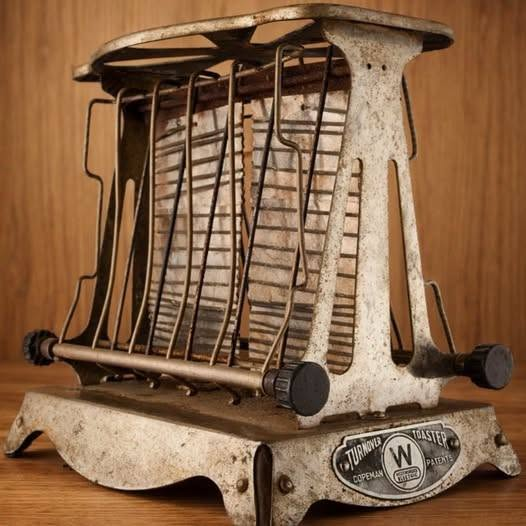
Every once in a while, an old household object resurfaces and leaves people completely puzzled. It may look familiar enough to suggest it belonged in a kitchen, yet its unusual design often makes people guess everything from a laboratory tool to an industrial machine.
One such object has recently sparked curiosity online.
Made of sturdy metal with exposed heating elements, wire holders, and rotating mechanisms, it looks nothing like the sleek appliances found in modern kitchens. Yet despite its unusual appearance, this fascinating device played an important role in everyday life nearly a century ago.
The object is known as a turnover toaster, an early electric appliance that helped transform breakfast during the 1920s and paved the way for the automatic toasters we use today.
A Glimpse Into Early Kitchen Technology
Today, making toast is incredibly simple. Place bread into a toaster, press a lever, wait a minute or two, and your toast pops up automatically.
But that convenience didn’t always exist.
Before electric toasters became common household appliances, preparing toast required constant attention.
People often toasted bread over:
- Open fireplaces
- Wood-burning stoves
- Gas flames
- Cast-iron grills
- Wire racks placed above heat
Because the bread had to be watched closely, it was easy to burn one side while leaving the other undercooked.
Breakfast required patience, timing, and plenty of practice.
As electricity became more widely available in homes during the early twentieth century, inventors began searching for ways to make everyday cooking faster and more consistent.
The turnover toaster became one of those important innovations.
What Is a Turnover Toaster?
Unlike today’s pop-up models, a turnover toaster relied almost entirely on manual operation.
Instead of hiding its heating elements inside a metal housing, the appliance proudly displayed its mechanical design.
Slices of bread were placed into metal wire cages positioned on either side of a central heating element.
As the heating coils warmed up, radiant heat gradually browned one side of the bread.
When that side reached the desired color, the user manually rotated the bread using side handles or knobs, exposing the opposite side to the heat.
Only after both sides were toasted evenly could the bread be removed.
It was a much more interactive process than modern toasting.
Built During the Age of Electrification
The popularity of appliances like the turnover toaster coincided with a major period of technological change.
During the 1920s, electricity was becoming increasingly common in homes across North America and many other parts of the world.
Families were beginning to replace manual household tasks with electrical appliances that promised greater convenience.
Early consumers could purchase devices such as:
- Electric irons
- Fans
- Washing machines
- Vacuum cleaners
- Coffee percolators
- Electric toasters
Each new invention represented another step toward the modern home.
Although these appliances may seem primitive by today’s standards, they were considered remarkable innovations at the time.
Why It Looks So Different
One reason vintage toasters attract so much attention today is their appearance.
Modern appliances are designed with smooth plastic exteriors that conceal their inner workings.
Early appliances took a very different approach.
Manufacturers proudly displayed:
- Heating coils
- Metal frames
- Mechanical levers
- Wire cages
- Rotating mechanisms
- Heavy steel construction
The exposed design reflected the engineering style of the era.
Rather than hiding the technology, manufacturers showcased it.
Many collectors appreciate these appliances not only for their history but also for their industrial craftsmanship.
Using the Appliance Required Skill
Operating an early turnover toaster demanded much more attention than modern appliances.
A typical routine looked something like this:
First, slices of bread were placed inside the wire holders.
The toaster was connected to an electrical outlet.
As the heating element warmed, the user carefully watched the bread begin to brown.
The user judged doneness by sight.
Once one side reached the preferred color, the side handle was turned to rotate the bread toward the opposite heating surface.
The second side was then toasted until both sides appeared evenly browned.
Finally, the bread was removed by hand.
Although the process sounds time-consuming today, many people appreciated the level of control it offered.
The Rise of Automatic Toasters
Technology advanced rapidly throughout the twentieth century.
Within a few decades, manufacturers introduced automatic pop-up toasters equipped with:
- Built-in timers
- Spring-loaded mechanisms
- Adjustable browning controls
- Improved electrical safety
- More compact designs
These improvements eliminated much of the manual work required by earlier models.
Instead of carefully monitoring every slice, users simply inserted the bread and waited.
This convenience helped automatic toasters become one of the most common kitchen appliances in homes around the world.
A Collector’s Favorite
Today, original turnover toasters have become sought-after collectibles.
Antique enthusiasts enjoy restoring and displaying these appliances because they represent an important period in the history of home technology.
Many surviving examples still feature their original:
- Metal frames
- Manufacturer badges
- Wire bread holders
- Heating elements
- Mechanical knobs
Years of use often leave behind beautiful signs of age, including worn finishes and natural patina that tell the story of decades spent in family kitchens.
Collectors value these details because they preserve a connection to everyday life from another era.
More Than Just a Toaster
Although it may seem like a simple appliance, the turnover toaster represents a much larger story.
It reflects a time when homes were changing rapidly.
Electricity was reshaping daily routines.
Household chores became more efficient.
Cooking grew more predictable.
Families gradually embraced technology that would eventually become so common people barely noticed it.
This toaster sits at the crossroads between traditional cooking methods and the fully automated kitchens we know today.
Appreciating Everyday History
Objects like this remind us that history isn’t found only in famous landmarks or museums.
Sometimes it lives in the ordinary tools people used every day.
Kitchen appliances reveal how previous generations prepared meals, managed households, and adapted to new inventions.
They offer valuable insight into changing lifestyles and technological progress.
Looking at an early toaster helps us appreciate just how much everyday life has evolved over the past century.
Final Thoughts
At first glance, this unusual metal device may seem difficult to identify. Its exposed heating elements, rotating wire cages, and heavy construction look far removed from the compact appliances found in modern kitchens.
Yet this vintage turnover toaster played a meaningful role in bringing electric convenience into everyday homes during the early twentieth century.
It reminds us that many of the simple tasks we now complete with the press of a button once required careful attention, patience, and hands-on involvement. More importantly, it tells the story of a period when innovation was transforming daily life one appliance at a time.
The next time you use a modern toaster, it’s worth remembering that breakfast wasn’t always so effortless. Behind every slice of perfectly toasted bread is a long history of creativity, engineering, and steady technological progress that began with remarkable inventions like the humble turnover toaster.