A Puzzle That Looks Easy at First
Every now and then, a simple math question spreads across social media and leaves thousands of people debating the correct answer. Unlike advanced equations or complicated formulas, these puzzles rely on something much more interesting: the way our brains interpret words.
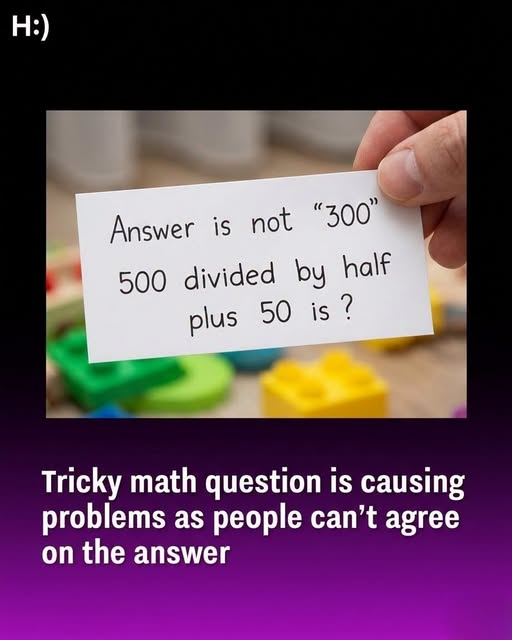
One of the latest examples appears almost too simple to cause confusion:
500 ÷ half + 50 = ?
Many people immediately answer 300 without giving it a second thought. Others confidently insist the answer is 550, while a growing number argue for an entirely different result.
So why does such an elementary calculation create so much disagreement?
The answer lies in one small phrase that many readers overlook.
Why Our Brains Rush to the Wrong Answer
When people read math problems quickly, they often rely on familiar patterns instead of carefully analyzing every word.
The phrase “divide by half” sounds very similar to “divide by two.”
Because “half” and “two” are closely associated in everyday language, the brain automatically substitutes one for the other.
That shortcut saves time in daily life—but it also creates mistakes.
This puzzle takes advantage of that natural tendency.
The Common Mistake
Here’s how many people solve it:
500 ÷ 2 = 250
250 + 50 = 300
It feels logical.
It feels obvious.
And that’s exactly why so many people stop there.
The problem is that the question never says divide by two.
It says divide by one-half.
Those are two completely different mathematical operations.
Dividing by One-Half Works Differently
This is the part that surprises many people.
Whenever you divide by a fraction smaller than one, the result actually becomes larger.
Think about it this way.
Imagine asking:
How many halves are inside 500?
Since every whole contains two halves, there are twice as many halves as there are whole numbers.
Discover more
Books & Literature
Language Resources
T-Shirts
That means:
500 ÷ 0.5 = 1000
After that, the remaining instruction is simple.
1000 + 50 = 1050
That is why the correct answer is 1050, not 300.
Why Dividing by a Fraction Increases the Number
Many people remember learning this rule in school but rarely use it afterward.
Consider a smaller example.
10 ÷ ½
This isn’t asking for half of ten.
Discover more
Romance
fashion
It’s asking:
“How many one-half pieces fit into ten?”
Each whole contains two halves.
Ten wholes therefore contain twenty halves.
So:
10 ÷ ½ = 20
The same principle applies regardless of the number.
A Helpful Way to Remember
One easy rule can help avoid mistakes like this in the future.
When dividing by a fraction:
- Dividing by ½ doubles the number.
- Dividing by ¼ multiplies the number by four.
- Dividing by ⅕ multiplies the number by five.
Because fractions smaller than one represent smaller pieces, more of those pieces fit inside the original number.
Why These Puzzles Spread So Quickly
The internet loves puzzles that seem easy but contain hidden twists.
People enjoy:
- Testing themselves
- Challenging friends
- Comparing answers
- Learning something unexpected
Simple math puzzles create immediate discussion because everyone believes the calculation should be straightforward.
When opinions differ, curiosity grows.
The Psychology Behind the Confusion
Psychologists often describe this type of thinking as using mental shortcuts, sometimes called heuristics.
Instead of reading every detail carefully, the brain fills in familiar patterns automatically.
Most of the time this helps us make fast decisions.
Occasionally, however, it leads us directly into a trap.
This puzzle works precisely because it encourages readers to rely on instinct rather than careful interpretation.
Reading Carefully Matters
The biggest lesson from this puzzle has very little to do with mathematics.
Instead, it reminds us to slow down.
Many mistakes happen not because people lack knowledge, but because they assume they already understand the question.
A single word can completely change the meaning of a problem.
That principle applies well beyond mathematics.
It also matters in contracts, instructions, recipes, workplace tasks, and everyday communication.
Math Is Often About Understanding the Question
Teachers frequently remind students that solving a problem begins with understanding what is being asked.
In this example, the arithmetic itself is extremely simple.
The real challenge is recognizing that “half” refers to 0.5, not 2.
Once that interpretation becomes clear, the rest of the calculation takes only a few seconds.
Similar Brain Teasers
Many popular math puzzles use the same strategy.
Some rely on:
- Order of operations
- Hidden wording
- Double meanings
- Fractions
- Percentages
- Visual tricks
These problems aren’t necessarily testing advanced mathematics.
Instead, they test attention to detail.
Why the Correct Answer Feels Surprising
Many people experience a brief moment of disbelief after learning the solution.
That’s because the brain had already committed to the first interpretation.
Changing that interpretation requires mentally restarting the calculation.
That “aha” moment is one reason these puzzles remain so popular.
They create a satisfying surprise while reinforcing an important mathematical concept.
Final Answer
Let’s solve it step by step.
500 ÷ ½ + 50
First:
500 ÷ 0.5 = 1000
Then:
1000 + 50 = 1050
Correct Answer: 1050
Final Thoughts
Simple math puzzles continue to capture people’s attention because they reveal how easily assumptions influence our thinking. Although the calculation in this problem uses only basic arithmetic, the wording encourages many readers to replace “divide by half” with “divide by two,” leading to an incorrect answer.
The real lesson isn’t just about fractions—it is about slowing down and reading carefully before jumping to conclusions. Whether solving a math problem, following instructions, or making everyday decisions, paying attention to small details often makes the biggest difference.
Sometimes the simplest questions teach the most memorable lessons, proving that even basic mathematics can still surprise us when we look a little more closely.